Summer camp activities for kids work best when there is something worth chasing, making, or figuring out together. Mix games that get everyone moving with projects children can make their own, then leave space for a quiet reset. These 54 summer camp ideas for kids give you supplies and enough direction to get play underway without scripting every moment.
Keep water and shade available, move indoors for thunder or unsafe heat, and reserve tools and heat sources for adults. Use this summer camp activities list to plan a few good choices, not a packed schedule.
1. Capture the Flag
Two cloth flags and eight boundary cones turn a field into rival territories. Teams of 12–24 campers split evenly, sneaking across the boundary while defenders watch for a dash toward their flag. Tagged visitors return home before reentering; bringing the opposing flag to your base wins. Leave five feet around flags unguarded so a bold runner has a chance.
2. Freeze Tag
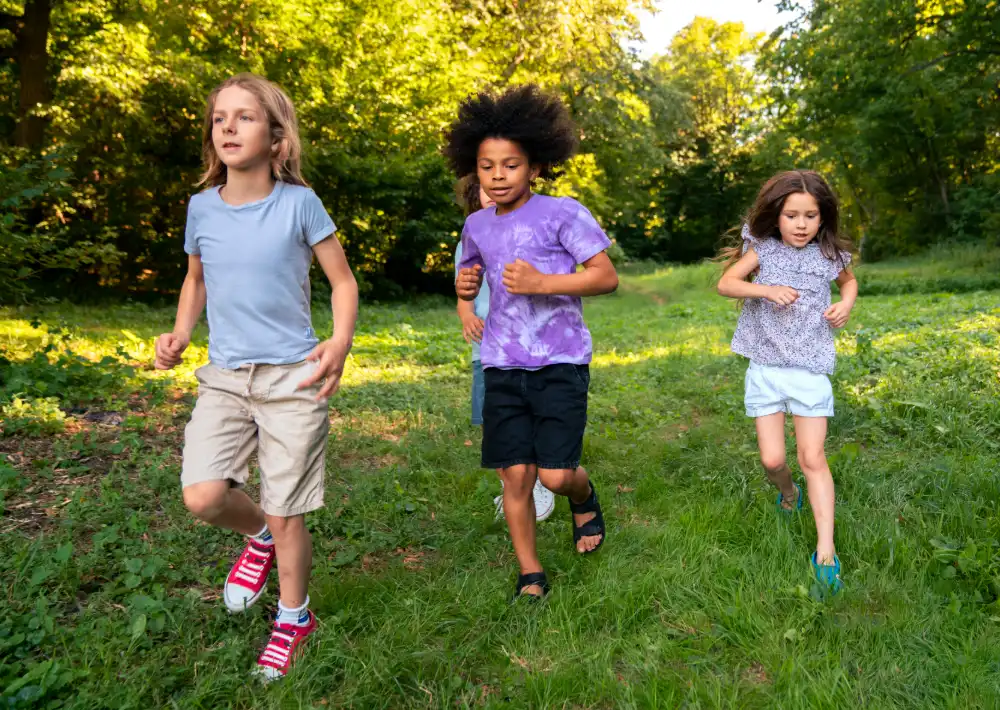
Choose two taggers to play ice wizards in a level, marked area. A gentle shoulder tag turns a runner into a frozen statue, arms posed like crooked icicles; a teammate’s high-five melts the spell. Rotate wizards every two minutes for five rounds. Walking tag keeps the chase manageable in smaller spaces.
3. Team Clue Hunt
Prepare four matching sets of five clues leading between supervised stations. A clue might read, “I have a back and legs but never walk,” pointing toward a bench. Teams must agree before moving on. At the last station, each team supplies one answer to a shared riddle, so finishing depends on everyone arriving.
4. Nature Color Hunt
Give each pair a paint-color card and a bounded walking route. An invented shade called “Royal Velvet” might match a crumpled leaf; “Moonbeam” could turn up on a pale pebble. Find three natural matches without picking anything.
5. Sponge Relay
Set out two sponges and four buckets, giving each team a full bucket and an empty one. Players hurry along a nonslip course with soaked sponges, trying to deliver water before it drips away. After equal turns, compare the buckets: all that frantic carrying can produce surprisingly little water.
6. Sponge Target Toss
Lay three hoops at different distances on grass and supply six wet sponges. After each round, move one hoop farther away to make it a traveling target. Every landing inside earns one point; everyone gets six throws. Keep the throwing lane clear, including faces, while campers decide whether to risk the longer toss.
7. Water Painting
A broad brush per camper and two shallow water tubs are enough for temporary pavement art. On shaded pavement, paint roads that join a neighbor’s picture or invent an animal too large for paper. Watch one design disappear through evaporation, then use the cleared space for something new.
8. Foil Boat Challenge
Give each camper a foil square and share a shallow water tub with 30 identical washers. Fold a boat, then have an adult add washers individually until it sinks. One redesign gives each builder a chance to act on what happened: perhaps the cargo needs spreading out, or the sides need another fold.
9. Sink-or-Float Lab
Gather eight waterproof objects larger than choking size and a clear tub. Include a solid steel spoon and a chunky piece of wood: the spoon sinks while the wood floats, challenging guesses based on size alone. Predict before lowering each object, then sort the results and talk about the prediction that surprised the group most.
10. Fizz Rockets
This is an adult-led outdoor demonstration using safety goggles and a plastic film canister with an internal snap-fit lid, never a screw cap. An adult adds one tablespoon of water and one-quarter Alka-Seltzer tablet, caps it, sets it lid-down, and immediately retreats with campers at least 15 feet. Use one launch; isolate failures for adult handling.
11. Bubble Wands
Bend one pipe cleaner per camper into a large loop with a handle, then dip it into a shallow tray of bubble solution. Compare a heart-shaped loop with a lopsided square: both can release rounded bubbles. Slow waves give campers time to follow a bubble before it drifts away. Keep solution away from mouths.
12. Chalk Town
Share one chalk box among four campers and divide the pavement into connected building plots. A dragon dentist could sit beside a library for giants, with paths wide enough for everyone touring the town.
13. Shadow Tracing
Stand a stick upright in modeling clay and trace its shadow with sidewalk chalk. Return after 20 minutes to draw it again. The two outlines reveal a shift in direction or length that was hard to notice moment by moment. Keep eyes on the pavement, never directly on the sun.
14. Ground-Level Obstacle Course
Use six cones, four hoops, and two floor mats for a Ninja Warrior-inspired route at ground level. One challenge might be crossing a crooked hoop trail without touching the rims, followed by a crawl across the mats. Campers travel individually and get two attempts, giving them a chance to improve control on the awkward section.
15. Animal Movement Trail
Space six animal picture cards along a short route. Include sideways crab steps and springy frog hops, letting campers invent upright versions when crawling does not suit them. Each card changes how the group travels to the next station. A slow tortoise walk brings the trail to an unhurried finish.
16. Parachute Waves
Space campers around a play parachute and put three foam balls on top. Gentle waves send bright balls skipping across the fabric; coordinated lifts make them pop together. Aim for three successful group lifts while keeping the balls aboard. Everyone stays outside the fabric, holding the edge without wrapping it around themselves.
17. Beach Ball Rally
Inflate one beach ball and form a generously spaced circle. Count consecutive upward taps, with nobody touching the ball twice in a row. Stop when the group beats its first score or completes five attempts.
18. Hopscotch Design
Draw a ten-space chalk course and provide one flat beanbag. Campers can turn the squares into numbered islands, then toss the marker and travel through without entering its space. Complete one circuit each, with stepping or wheelchair-accessible routes built into the design.
19. Flying Disc Targets
Set three hoops on grass and supply three soft discs. Give the nearest hoop one point and let campers assign higher scores to harder targets before play begins. Everyone throws from one marked line while others wait behind it. Retrieve together after each round and compare strategies over three rounds.
20. Jump Rope Lab
Give each pair a rope and enough room to stay beyond other ropes’ swinging distance. Begin with single jumps or double-foot hops, then add a familiar playground rhyme or invent a short chant. Each pair teaches another its favorite move. A stationary rope offers a stepping version without the swinging challenge.
21. Leaf Rubbings
Gather three fallen leaves, two paper sheets, and two crayons per camper. A lobed oak leaf or pointed maple leaf gives a distinctive outline beneath the paper. Place leaves vein-side up and rub with the crayon’s side until the ridges emerge. Layer the shapes and label textures the campers can actually see.
22. Pressed Leaf Bookmarks
Provide two prepressed leaves, a cardstock strip, and clear adhesive film per camper. Arrange the dry leaves before covering both sides with adult help. Round the corners and choose a book for the finished marker.
23. Friendship Bracelets
Tape three 24-inch embroidery-floss strands to the table for each camper. Beginners can braid a simple band; campers comfortable with knots can build repeating stripes. Stop when the bracelet fits loosely and can be removed comfortably.
24. Cardboard Weaving
Adults prepare small, notched cardboard looms, with yarn for vertical supports and fabric strips for weaving. Pass each strip over and under, reversing the path on the next row. Size the loom for a complete little square mat or coaster, then tie the loose ends so campers leave with a finished piece.
25. Paper Animal Masks
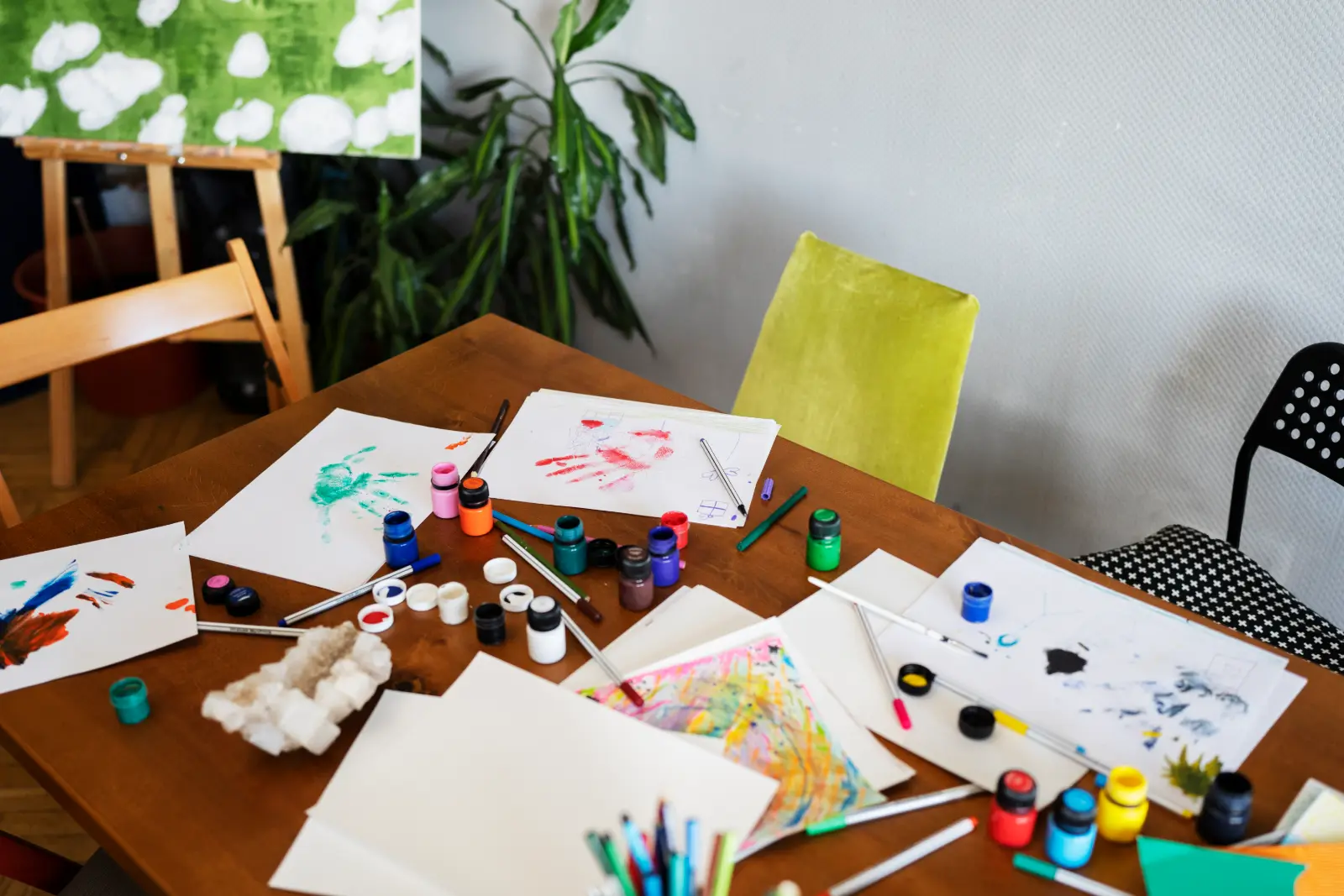
Give each camper a paper plate, craft stick, and crayons. Draw an animal face, have adults cut generous eye openings, and attach the stick as a handle instead of using ties. Finish with an animal parade: a solemn mouse voice coming from an enormous lion mask can become the whole joke.
26. Clay Creature Workshop
Start with a palm-sized lump of air-dry clay per camper. Shape the creature from that single piece, pulling out horns or fins and pressing scales with a craft stick. Ask where such a creature would live. Its answer can guide the final details before it moves to a labeled drying tray.
27. Camp Postcards
Hand out blank postcards and share markers. Illustrate a real camp moment on the front, then write about it on the reverse: perhaps a sponge-relay soaking or an opinion about lunch. Deliver finished cards to a camp mailbox. Adults can handle mailing while campers decide which small event deserves a message home.
28. Nature Journals
Fold four paper sheets per camper, bind them with yarn, and add a pencil. Choose one outdoor spot to investigate closely: a crack beside a bench might be more interesting than the whole field. Sketch a detail, date the page, and record something seen alongside a question worth returning to.
29. Bird-Watching Bingo
Make nine-square cards for pairs, using behaviors such as hopping and perching instead of requiring species names. Settle quietly for 20 minutes and mark what actually happens without approaching nests. A full card is optional. Sharing one sighting gives even a pair with mostly empty squares something to contribute.
30. Cloud Sketching
Sit in shade with paper, pencils, and an open sky view directed away from the sun. Campers might spot a dragon, an anvil, or a face before sketching one cloud twice, five minutes apart. Compare the drawings: did the dragon lose its tail, or did the face become something else entirely?
31. Bug Observation
Share one magnifier per pair and search plants or soil without touching or collecting insects. Beside a rotting piece of bark or along a stone’s edge, look for moving antennae and tiny legs. Draw the visible body parts rather than relying on a familiar cartoon bug. Leave stinging insects and occupied nests undisturbed.
32. Seed Sprouting
Give each camper two bean seeds, a paper towel, and a clear cup. Dampen the towel and position the seeds against the cup wall in indirect light. Label the cups and return to watch the seed coat split and a root emerge. Drawing each change makes the waiting part of the project.
33. Sun Prints
Arrange flat objects on one sheet of sun-print paper per camper while still in shade. Move it into sunlight and watch the exposed paper change color, using the paper’s directions for exposure and rinsing. After drying, compare a solid object’s silhouette with a lacy outline: the empty spaces become part of the picture.
34. Windsocks
Decorate one cardstock sheet per camper, roll it into a cylinder, and attach four tissue-paper streamers with a short hanging loop. An adult chooses the hanging point. Watch what happens when a gust arrives: the streamers that hung limply begin whipping together, giving the finished craft something to do.
35. Rain Gauges
Give each pair a straight-sided clear container, ruler, and waterproof marker. Mark quarter-inch intervals from the inside bottom and secure the gauge upright outdoors. Before waiting for rain, use a watering can for a practice reading. Empty it afterward so the next recorded depth, in inches, belongs to the rainfall alone.
36. Paper Bridge Challenge
Each team gets six paper sheets, tape, and two books set six inches apart. Build a bridge across the gap, then add identical blocks until it bends. Allow one redesign and retest. The useful question is specific: which fold or support will the team change after seeing where the bridge gave way?
37. Ball Ramps
Use cardboard channels, blocks, and one large ball per team to build a low route below knee height. Release the ball without pushing and follow its clatter around cardboard corners. Adjust the troublesome bend until the ball reaches a marked landing zone three times. A successful route matters more than a tall structure.
38. Cargo Drop
Teams receive one toy figure, four paper sheets, tape, and string to build a protective carrier. An adult drops each carrier from shoulder height. After the first test, campers can change whatever let the passenger shift or escape. Test once more and compare whether the figure stayed secured, not whose carrier looked fanciest.
39. Paper Airplanes
Give each camper two sheets of paper to fold and name a plane. Launch toward an empty landing zone, then change one fold and test again. Keeping the change small gives the comparison a point: campers can describe what happened to the flight instead of simply declaring one plane the winner.
40. Blanket Forts
Drape four lightweight sheets over sturdy tables and secure them with clips, leaving exits clear. Build an entrance and a reading area without climbing on furniture. Once the group agrees where everyone can sit, share a story inside.
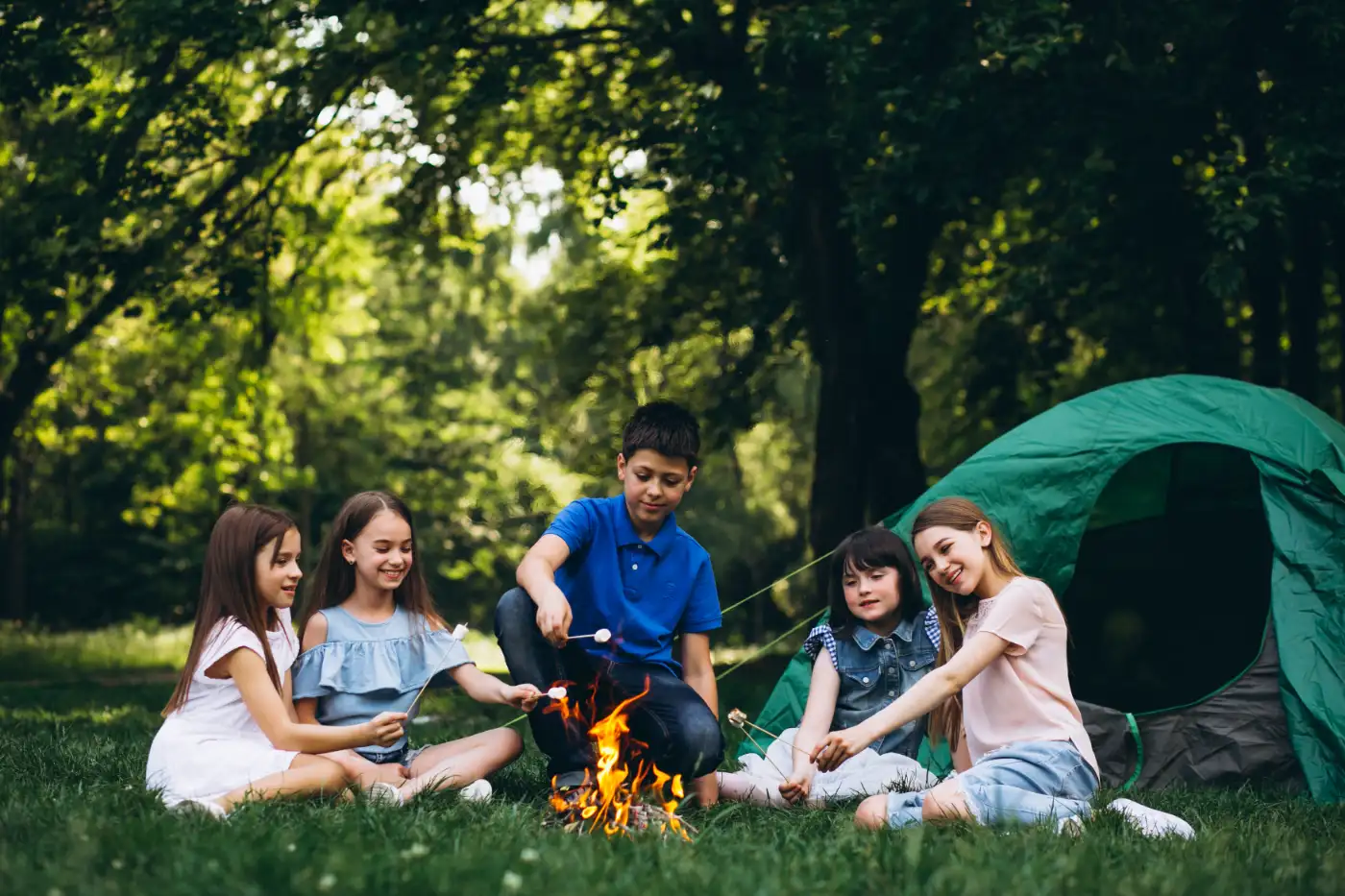
41. S’mores
Allow two graham-cracker squares, one marshmallow, and one chocolate piece per camper. Adults establish a fire boundary and supervise turns with long roasting sticks. Assemble the sandwich and let it cool before eating; adults fully extinguish the fire. When fires are restricted, make a no-fire version and keep the shared snack ritual.
42. Fruit Cups
Provide half a cup of prepared fruit and a cup per camper. After handwashing, distribute individual portions for layering with spoons. Children can choose the order of their fruit before eating together. Adults prepare round fruit by cutting it lengthwise into age-appropriate pieces, leaving the assembly to campers.
43. Snack Mix
Offer three tablespoons each of approved cereal and dried fruit per camper. Review labels against documented allergies and use separate scoops for individual cups. Campers name the ingredients before eating, making the contents clear to everyone. Choose substitutions with textures suited to their chewing abilities.
44. Solar Chocolate Melting
Each team needs a pizza box, foil, clear wrap, and four chocolate squares. Adults prepare a reflective flap and covered window; campers compare chocolate placed inside in sunshine with a shaded sample. Look for softening, not a cooked snack: this is an experiment, not a food-safety cooking method.
45. Reading Picnic
Gather blankets and one book per camper for a 15-minute reading session. Offer independent reading alongside a read-aloud corner, with wordless books available for younger readers.
46. Story Circle
A counselor begins with one sentence about a lost camp mascot. Each camper adds a sentence or passes, sending the search somewhere the previous speaker did not expect. Announce when three turns remain so the group can bring the mascot home. That warning gives the ending a chance to make sense.
47. Camp Skits
Set out six prop cards and a costume basket for small groups to choose from. Rehearse two-minute skits, then perform for one another. A narrator can carry the story while other campers handle props or greet the audience. Those jobs let children contribute without requiring everyone to act a part.
48. Talent Showcase
Use a sign-up sheet and timer for demonstrations lasting up to two minutes. Displayed artwork and group demonstrations count, so the program need not depend on solo performers. Willing campers can host or help backstage. Finish after every scheduled act has received applause, without ranking the talents.
49. Rhythm Circle
Share one sealed shaker or hand drum per pair and establish a slow beat. Campers take turns offering short patterns for everyone to echo. Quiet hand motions are an equal way to join in. Gradually soften the final beat until the circle reaches silence together.
50. Sound Maps
Give everyone paper and a pencil, with a mark at the center representing their seat. Sit quietly and place symbols where sounds seem to originate. Compare nearby and distant sounds afterward. Different maps are useful: two campers may have paid attention to entirely different parts of the same place.
51. Stretch-and-Breathe Break
Space campers an arm’s length apart for comfortable shoulder rolls and gentle reaches. Follow with ordinary, unforced breathing, without breath-holding contests or forced stretches. Finish by inviting a word or signal about how their body feels. Passing is fine; this is a pause, not another performance.
52. Cooperative Board Games
Provide one age-matched cooperative game per four campers and explain its shared goal. Rotate who makes decisions so one confident player does not run the table. At the game’s stated endpoint, identify one useful team decision. Losing can still leave the group with a strategy it wants to test next time.
53. Kindness Cards
Give each camper two index cards and shared markers. Focus on a specific helpful action, such as making room at a table, instead of appearance. Write or draw appreciation and deliver it privately. Counselors make sure nobody is excluded, without turning the cards into a public popularity count.
54. Camp Mural
Secure a long paper roll at accessible heights and offer washable markers. Give campers connected spaces for favorite camp memories, letting neighboring drawings meet along the edges. End with a gallery walk where artists can explain or simply point. The shared paper holds different versions of the same camp day.
Key Takeaways
- Choose a few activities with different energy levels instead of filling every minute.
- Let campers shape the story, design, or strategy within clear rules.
- Prepare adult-led experiments separately from independent making.
- Give shared projects meaningful roles beyond speaking or performing.
- Keep an indoor substitute ready for outdoor plans.
Frequently Asked Questions
What are some fun summer camp games?
Capture the Flag and freeze tag suit campers who want a chase, while beach ball rally offers a shared challenge. For fun camp activities without running, choose a team clue hunt at walking pace or a rhythm circle.
What are some fun summer projects for kids?
Cardboard weaving and nature journals give campers something to keep and develop. For shared camp crafts, choose the mural; for children who enjoy testing changes, choose paper bridges or foil boats.
Which activities can move indoors if it rains?
Paper bridges, storytelling, and cooperative board games work indoors. Choose table-based camp activities when floor space is limited, and reserve a clear landing zone if you bring paper airplanes inside.
How can counselors adapt these ideas for mixed-age groups?
Offer different tasks within the same activity, pairing younger campers with willing older partners without transferring supervision. One child might draw a journal observation while another writes its caption. Let ability and interest guide the pairing.
Which activities need extra checks for heat, food allergies, or small parts?
Outdoor games, food projects, and activities using washers or loose craft pieces need those extra checks. Schedule active play around heat and review food ingredients against documented allergies. Keep fizz rockets under direct adult control and choose materials appropriate to campers’ handling abilities.
Build a Balanced Camp Day
Choose your first activity by looking at your space and the adults available. A field and an energetic group point toward a chase game; a table and campers who want to make something point toward weaving.
Plan one change of pace after that first choice. Follow movement with making, or a demanding building challenge with the reading picnic. Put supplies in separate bins and choose an indoor substitute before campers arrive. Keep the final choice flexible: a group absorbed in its mural may need more time, not another activity.